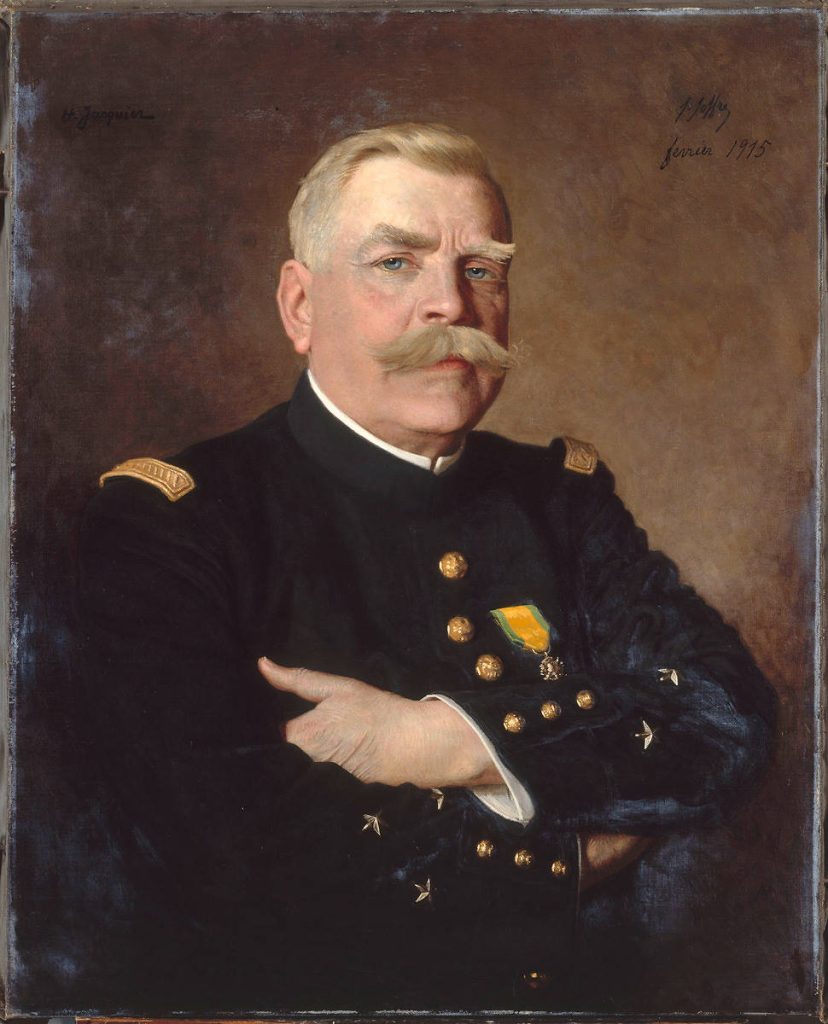
That is a picture of a man who is pretty much universally denigrated in the history books: Joseph Joffre, Marshall of France. He was in command of the French army for the first two years of World War One and the massive slaughter of those two years is laid at his feet and condemns him before the bar of history as a man who pointlessly sacrificed French youth for nothing. And, indeed, he made his mistakes. On the other hand, who hasn’t? Even when we consider the greatest commanders, we still have Napoleon blowing it at Waterloo and MacArthur being caught with his pants down hours after receiving word of the Japanese attack on Pearl Harbor.
You can’t get past the number of French soldiers who died and that will always remain a horror but in judging the actions of people, one must always first place yourself in their shoes. Joffre was an experienced officer with a background in engineering and logistics. In other words, on paper exactly what you want. He was also a man who was impossible to panic – no matter how bad things were going, he was going to remain calm and rapidly issue decisive orders. Anyone who knows history – especially military history – knows that calmness plus the willingness to act are crucial in war. History is filled with generals who either lost their nerve or simply became paralyzed with indecision. Better a bad decision gets made than no decision at all. In sum, Joffre was not an idiot, nor in inhuman monster. He was presented with a puzzle and did his best to solve it.
His first puzzle was trying to figure out the best way to deploy his armies at the start. Can’t use hindsight! He only knew for certain that the Germans were coming and would likely make a significant effort in Belgium. But in those days of armies moving no faster than marching feet, he knew he’d have time to watch any such move develop. He could have deployed his main armies along the borders with Belgium. But what if the Germans then decided to advance south of Belgium? It is like that in war: trying to guess through a fog what is best. Taking one thing with another, Joffre’s decision was to launch the French attack in what amounted to the center of the German line – the idea being to split that line and flank the Germans marching into Belgium. This is, actually, a pretty good plan. There was only one major flaw: the power of defense.
The French hadn’t fought any major military action since 1870 – when machine guns were unknown, field artillery was much less lethal and the primary firearms were single shot rifles. The French had, of course, kept abreast of military developments but reading a report isn’t fighting…and they just had no conception of the power of a dug in enemy. The Russians knew it as they had fought the Japanese in 1905. The Brits knew it as they had fought the Boers in 1901. The French had no idea. Of course, neither did the Germans, who also hadn’t fought a major engagement since 1870. They were, together, military babes in the woods…and they both launched their armies right at each other and both got a massive and bloody wake up call. But the Germans were able to keep advancing because, as it turns out, they had placed almost their whole army into Belgium and simply had overwhelming weight of numbers. Given this, the French and their British allies were compelled to retreat…but only until they got themselves reorganized to stop the Germans. Which they did, at the Marne.
Whole libraries have been written about that battle which marked the highwater mark of German advance in 1914 and their forced retirement after the French counterattack. Who did what, which orders were given by whom are matters of deep study; mostly trying to show that someone other than the commander, Joffre, had been decisive. What was it, really? After the war, Joffre was asked who had won the Battle of the Marne and he answered, “I cannot say for certain, but I know who would have lost it, if it had been lost.”
After that, Joffre’s puzzle was how to expel the Germans from France – which is of course what you want to do if you’re a French officer and German’s occupy about ten percent of your country. Joffre tried this method and that – each time modifying the program a bit based on lessons learned. But, in the end, under Joffre’s tenure, the magic talisman to break a line defended by barbed wire, trenches, magazine rifles, machine guns and artillery was not discovered. Various important steps were taken – including the development of aerial bombing while the first French tanks were created in 1915 – but the total mechanism for crossing a bit of ground swept by enemy fire and breaking through an entrenched enemy force was not found by the time Joffre was kicked upstairs in the aftermath of the Battle of Verdun in 1916. Naturally, the efforts Joffre made were costly in lives and this, as noted, is laid at his feet and used to condemn him…make him out to be some sort of insensate monster fruitlessly sacrificing French lives.
But what else was he supposed to do? Just leave the Germans alone to build their strength until they could attack? Surrender? The enemy had to be expelled…Joffre and every other officer involved had no idea how to do it. You can only think it over, come up with ideas and then try them out. And, in the end, the ideas tried out by Joffre (massive heavy artillery – which Joffre had wanted pre-war but was denied the funds to procure – tanks and planes) were put together by his ultimate successor, Foch, and the deed was done – the Germans were defeated and expelled from France.
I bring all this up because I think we have a problem in our society in that we tear down those who do – and honor the guys in the peanut gallery who never do anything. Especially in light of the response to our campaign against Iran we’re seeing this. For forty seven years everyone sort of sat there and left the mullah regime alone – there are probably lots of reasons for this (all bad) but the bottom line is that today we have those who let this cancer fester upset at the man who proposes to excise it from the global political situation. The past forty seven years show what you get when you aren’t willing to at least try. If the fact that getting the Germans out of France was to be a bloody business prevented French action, then the Germans would still be there…the war might have gone on much, much longer with an ultimately higher cost in lives. Something had to be done both back in 1914 and here in 2026. And all honor to those who are willing to do something, even if they make mistakes doing it. Better to have a mistake than to have a drift.
Things must be done. Someone has to come up with the moral courage to act…and often act on very incomplete information and with no certainty they’ve come up with the right response. As Wellington put it, the whole art of war is getting at what’s on the other side of the hill – you don’t know what’s there, but you must do it. We’ve been half a century so fearful of that other side of the hill that we’ve essentially done nothing – and worse than nothing because we have killed a lot of people (had a lot of ours killed, too) and expended huge amounts of money while essentially cowering over on our side of the hill.
Trump is doing what should have been done on November 4th, 1979…and every day since. We’ve got a regime in Tehran which is mere social pestilence upon the global body politic. It had to go and must go. Trump just has the courage everyone else lacked (when they weren’t bought by Iranian or other foreign money – there is that, as well). The glory is his – he looked at the situation, realized it had to be solved and has decided to solve it. His opponents are in the wrong – not just on technical aspects, but in the larger moral requirements of being human.
 Blogs For Victory
One of my triggers of rage-blogging has been my observation that global warming is a good thing. That very observation has led to a significant rise in the temperature, at least in my general online vicinity. I have pointed out that one thing I have found to be dishonest and deceptive about the whole “it’s going to get so hot we will all DIE!” panic is the refusal to acknowledge the benefits of warmer temperatures, such as reducing the drain on resources needed to survive and the increase of food supplies.
So I was really interested in this article today, titled The Ultimate Climate Warming Heresy Is That It Might Be …Good… For Humans, Actually? with the subtitle “Because the history of climate warming is correlated with human flourishing, actually”
The article actually touches on two issues, the first being “What risks do we create by associating ‘science’ in the public mind with expensive public policy disasters? Americans no longer trust ‘the experts’ like they used to.” This is not well-developed in the rest of the article, but it is still very important, as we have seen the erosion of respect for the credentialed class, including “scientists” but really all “experts” and I haven’t seen any dissertations on possible harm resulting from this growing skepticism of alleged expertise. (One might title such a dissertation “The Boy Who Cried Wolf Effect On The Ability To Advance True Science”).
The main focus of the article, though, is this:
That link to the article about the DNA bottleneck is fascinating. Here it is somewhat casually referred to as “mass death” but the article explains the effect of reduced mortality and reproduction on the development of humanity. And then the author bluntly states the conclusion that “Cooling is consistently associated with the suffering of the human species.“
“Cooling is consistently associated with the suffering of the human species.“
And there you have in a nutshell the underlying reason why some people want the planet to be cooler. There’s one other thing that is consistently associated with human misery: Leftism.
The thing is, it’s going to get cooler anyway. That is the pattern, and we have been getting warnings for a couple of decades now that we will be entering an extended cooling period. Maybe not another Little Ice Age, but a lot cooler than it is now. I’m not sure if the Left truly has wanted the planet to cool enough to have that effect, nearly as much as they wanted the control associated with forcing people to go along with the grift—and, of course, the grift itself. The forced redistribution of wealth is the political power, and the enrichment of some elites is the grift. I never got the impression that the Left truly cared about stopping the gradual warming they howled about, much less reversing it, because they needed it to support their agenda.
People have no idea how much the climate has changed in such a relatively short period of time.
“Between 1309 and 1814, the Thames froze at least 23 times and on five of these occasions -1683-4, 1716, 1739-40, 1789 and 1814 – the ice was thick enough to hold a fair.
The ice was thick enough to support printing presses churning out souvenirs. Oxen were roasted in front of roaring fires, drink was liberally taken and dances were held. An elephant was marched across the river alongside Blackfriars Bridge.
It was February 1814. George III was on the throne, Lord Liverpool was prime minister and the Napoleonic wars would soon be won.
People didn’t know it then but this “frost fair” – a cross between a Christmas market, circus and illegal rave – would be the last.”
212 years is a eyeblink in geological terms. We were already a sovereign nation during the last days of the last Little Ice Age.
Up and down it goes – the Late Bronze Age Collapse was probably the result of changing climate: the Minoan civilization was getting highly advance and then, poof, overnight it was gone … the world had gone through one of its periods of warm, mild weather than that was over. Things got rough all over for centuries. The Pax Romana was enforced by the Legions…but the Legions were strong because the climate was mild…but also about a degree warmer than in the modern era. Romans were able to do what they did because they had plentiful food due to warm and wet summers and mild winters. Meanwhile, the Crisis of the Third Century mixed political instability with a rapidly cooling climate which reduced food production that, in turn, weakened the population and made it more susceptible to disease which cut huge swaths through the Roman population…at a time when Rome needed a growing population to fight off the barbarians pressing on the borders.
There have been times in Earth’s past where there was no ice, at all – not even at the poles in winter. The Earth has been both a lot warmer and a lot colder than today…and yet in both the extremes of cold and heat, life went on. But, on the whole, it flourishes best when it is warmer. You think of the vast lands in Siberia and northern Canada which are not really livable by humans today…warm this place up a bit and suddenly you’ve got a beach resort north of the arctic circle!
But in what I have found, we are far more likely heading into a long-term cooling trend than a warming one…because (here’s the kicker) we’re still in the Ice Age…just an interglacial period of it. Happened before! About 100,000 years ago (as noted in your article). Of course, on the normal human time frame, we’re still talking a thousand or more years before it is massively plus or minus either way (warming or cooling). It is not something we need to worry about…and while glaciation happens rapidly in geologic time scales, it happens slow enough on the human time scale that we’ll be able to adapt. As for plant and animal species…90% of all such that have ever lived are extinct. The ebb and flow of life on Earth is the rise and fall of species…which are well adapted to these conditions but not well adapted to those…and as those ill adapted die out, the next phase rises to the fore.
I never cease to be amazed at the intellect (or lack thereof) that believes we only have 10 years left to save the planet. The original message to that effect goes back to the 80’s, so we are about to enter the fifth decade of that alarmist message being repeated to ignorant ears.
When you examine the internal structure of Leftism, aside from the purely political (which is immaterial to most of the members of the movement anyway) you see the bizarre intersection of magical thinking, ignorance of historical fact, indifference to historical fact, and denial of fact raised to almost an art form. One example is the shrill bleating about how THE ARCTIC ICE IS MELTING TO THE LOWEST LEVEL IN ALL OF HISTORY AND CAN NEVER BE RESTORED AND THIS SPELLS DOOM FOR HUMANITY followed by a few very slow eye blinks if we mention the crossing from the Atlantic to the Pacific via the Northwest Passage by Roald Amundsen, the first European to complete the Northwest Passage by sea, in 1903-06. There are Inuit legends of prior crossings by boat by natives, before this. But Amundsen did it, then the route froze closed again, then thawed again, then froze again, and so on. And in the past few years we have had reports of “record levels” of Arctic ice. (This is the kind of information that triggers the ignorance of historical fact, indifference to historical fact, and denial of fact, leading to the magical thinking of believing that referring to a story of some Eskimo village falling into the sea means the whole NW passage thing just never happened.)
Speaking of the Arctic, which I was kind of doing, I recently read that the Antarctic got its name because the Arctic has polar bears, so the opposite pole got a name based on “no bears”.
One of the cards the hysterical minded play is modern industrialization, something that was not in existence in much before a few hundred years ago, the thing they claim is a major cause of “climate change”. “Climate change” terminology was adopted largely because that would allow them to easily shift from / to, warm / cold claims without having to provide any evidence or explanation. The whole scheme is a financial power play by creating panic on the weak minded.
This is similar to the same hysterics pandered in my youth about overpopulation. Not enough food or energy to sustain growth. Now, with a few billion more people and still a fair amount of vast open lands, we’re seeing an aging population and the decline in birthrates. Lack of food could certainly concern people. Greater demand for energy is also creating discomfort for many and forcing change in habits. But it is that very discomfort that spurs the innovation.
With the quick explosive development into AI the demand for massive data centers grows, which in turn places a significantly greater demand on power needed to run and cool these centers. Elon Musk is working on sending large scale solar collection systems into space where cooling is not a concern and the sun is in constant abundance. There’s an old saying; “Necessity is the mother of invention”. Industrialization is not the “cause” of our problems but the solutions. Change is certainly accelerating which is forcing greater adaptability. To be sure, there will be winners and losers in how quick people adjust and choose with some level of foresight. The losers will forever claim oppression instead of making better future choices (because that takes work and accountability) and the greedy will exploit wherever they can because evil still exists.
The things that have the greatest effect on our day-to-day living is large scale natural disasters (and no, this slow moving climate change is not among those), and global wars, especially if they go nuclear.
I keep seeing this claim about the SAVE Act. and wonder if it is accurate.
“Proof of citizenship required for voter registration, such as a passport or birth certificate”
That is, does anyone know if a REAL ID qualifies as proof of citizenship?
From what I understand, it does
Yes, the requirement for a Real ID is a valid birth certificate or valid passport, so a real ID is the best form of ID.
That is what I thought, and what I wish the reports would say, instead of saying that a birth certificate or passport is required to prove citizenship to register to vote. I wish we would stop doing the Left’s work for it.
Well, technically a birth certificate or passport IS required to vote, because you can’t get a Real ID without one or the other.
You know that. I know that. Rational people know that. Intelligent people know that. It is likely that the mole people know that. The Dem base? Probably not, making that little misstatement a radioactive weapon in the hands of the Left. THOSE POOR IG’NRANT BLACK FOLK CAIN’T BE EXPECTED TO TRACK DOWN BIRTH CERTIFICATES! and so on. Not to mention those poor ig’nrant wimmen folk who can’t even figure out how to get their names changed when they get married much less get a copy of a birth certificate.
It’s just semantic infiltration, and we do it all the time. All of a sudden every article, even in a “conservative” newsletter, uses the term “abortion rights“. We dutifully parrot election fraud deniers using phrases like “not enough to change the outcome” as if that matters.
We need a semantics detective to scan everything and weed out those pernicious supporting words and phrases that let falsehoods enter into common usage and then be accepted as true.
I could not agree more.
My question is, are there really any US citizens who don’t have the necessary ID to vote, given that it is basically required for many things that most everyone already engages in? I’m sure there are a few in the fringe, but the way the democrats frame it is this law will create mass disenfranchisement. Given that even the notable majority of their own base favors this, the only explanation for resistance that makes sense to me is a fraud so important to their election that it would expose the depth of their criminal activity and sideline them for at least the next generation.
“the only explanation for resistance that makes sense to me is a fraud so important to their election that it would expose the depth of their criminal activity”
To some extent I think this is true—-they have operated with impunity, confident in the assurance that they controlled the levers of justice so had nothing to fear, and the prospect of losing that control and seeing true justice being administered must be terrifying. But never underestimate the lust for pure power.