Still much to do and many rocks and shoals to navigate around, but it does look at this time like Trump will be able to arrange some peace between Russia and Ukraine. The sticking points will be how much territory Ukraine has to give up and how much of a security guarantee for Ukraine Russia is willing to tolerate. Make no mistake about it, Putin likely isn’t giving up the dream – token US or NATO forces in western Ukraine won’t bother him…a brigade or two near the new eastern border would. Meanwhile, Zelenskyy has the fear that peace will bring an election he’s likely to lose – and then face the music for how the war was conducted – while plenty of Ukrainian power players will be willing to stoke anti-Russian fires for domestic political purposes. It is a tricky situation!
But the pragmatic facts of life are that neither side can afford to continue – last I heard the Ukrainians were drafting kids and old men while Russia seems to increasingly rely upon mercenaries to fill the ranks. Keep in mind that Total Fertility Rate for Ukraine is 1 and for Russia 1.47 (and a lot of that is probably non-Russian ethnic minorities): these countries aren’t producing a lot of fit, young men year by year. Nobody knows how many people have died in the war – both sides lie egregiously about casualties – but its probably some hundreds of thousands dead: and whatever the number of dead the best way to estimate wounded is times two of the dead figure. It is probably in the neighborhood of a million dead and wounded between the sides…this is being bled white. And ultimately for nothing. Putin and Zelenskyy must get out.
This was the image of the day – and maybe an image for the ages:
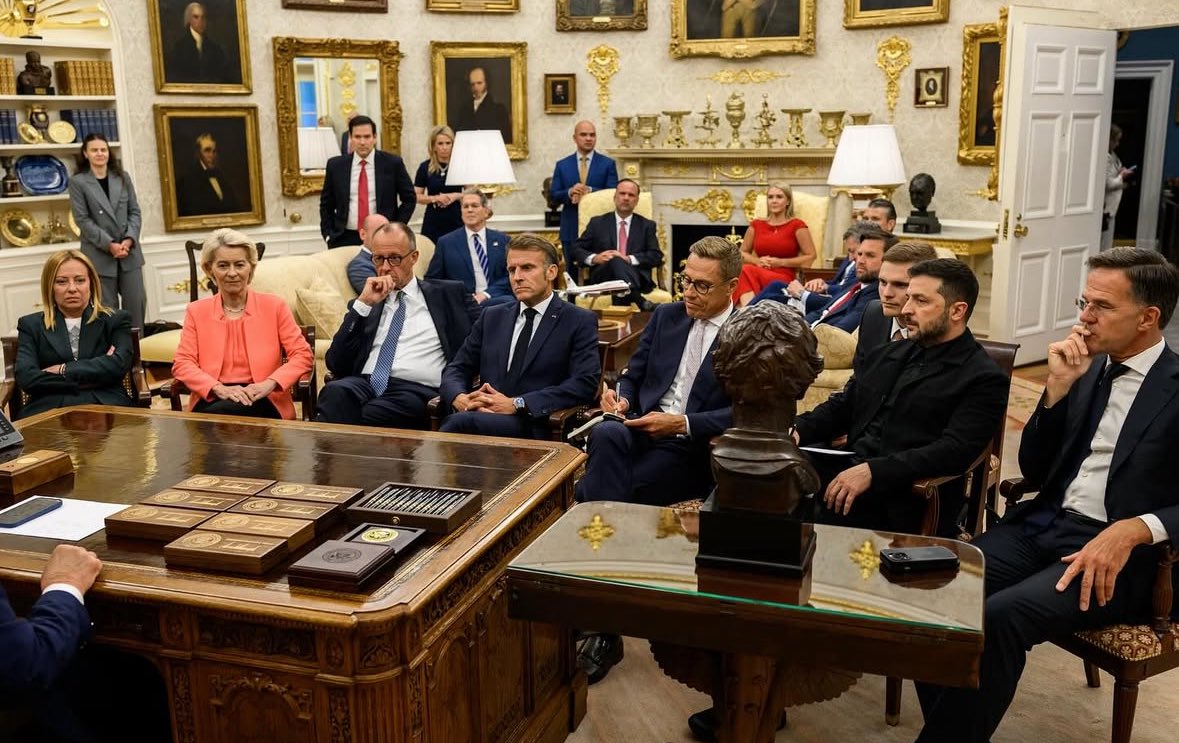
They’re all waiting on Trump – each and every last one of them totally irrelevant to how this will come out. Trump will decide – and he’ll ultimately decide for Putin and Zelenskyy. The may buck and they may kick and scream and perhaps even derail this particular effort…but eventually they all will have to knuckle under. There is no power like the USA elsewhere in the world. It has been thus since 1945…and the only foreign policy problem we’ve had since then is our refusal to act like we are the most powerful. We’ve been playing this weird game where we let second and third rate powers talk to us like they matter…that we have to get them to agree with us, rather than ultimately just issuing them orders on how to behave. Trump instinctively understands that even in our currently weakened State, we still hold all the cards.
It isn’t as odd as you think – from 1815 to 1914, the world waited on decisions from Whitehall in London. The British government essentially had veto power over everyone else – their sea power gave them this and nobody could really argue with them. And the British didn’t fuss with the concerns of second raters – they were just told what to do and if they tried to fight it they’d swiftly find a British fleet off their coast. The power vacuum we allowed to exist since 1945 is now being filled. By Trump.
 Blogs For Victory
This Russia/Ukraine war is going to go down as one of the most monumental wastes of blood and treasure in my lifetime.
Huge waste – whatever Putin thought he was doing he expended more Russian wealth and blood than it was worth. He’s got a dying nation on his hands and he’s trying to pretend he’s Peter the Great.
This article is a little different from what we usually discuss, but I think it touches on an important aspect of growing up that has become buried in the noise and chaos of modern life. The name of the article is The Knight’s Tale: How Myth Gave My Son a System of Meaning and it is about using the myth of knighthood to build a framework to help an autistic child develop ways to live and function in a world that autism made incomprehensible.
But as I read it, I realized that this has always been a process to help children form personal identities. Maybe not in such a specific and structured form, as these parents had to do for their autistic son, but through years of lessons taken from Bible studies and history and literature and oral family histories. There have always been stories of unselfishness and accomplishment and courage and nobility, held up to children as aspirational. And I don’t see as much of that any more.
As a child, when someone in the community did well, the message from my parents was that I, too, could do the same, if I put in the work. But now I see the message in so much of society not of striving to reach a goal of success but to drag down those who have succeeded. We’re not hearing of Horario Alger, or how Elon Musk taught himself rocket science by reading a lot of books. How many young people today have learned about a young Abraham Lincoln educating himself by firelight with borrowed books? Instead of reading T.H. White’s The Sword in the Stone and absorbing the lessons of character and perseverance illustrated in Wart’s adventures and his own growth as a person, kids spend a few minutes watching a frivolous cartoon version stripped of message and nuance.
The true story of the creation of this country, from the dedication of the Founders and their faith and their courage to the things that can only explained as divine intercession such as the sudden fog that descended over the Delaware River allowing Washington’s men to cross undetected by the British, are all inspirational and aspirational, and unknown to generations of Americans . Today we see performative declarations of commitment to politically generated “causes”, in “protests” and cosplaying by people who know if they do get arrested they will be free in hours with new street cred, instead of the powerful “We pledge our lives, our fortunes, and our sacred honor” of true character and commitment.
Every civilized society has built its next generation on its stories, legends and “myths” to create frameworks of character, achievement and various kinds of success. And it feels that we have started to outsource that responsibility to technology, public education and the entertainment media. For every “Braveheart” we have thousands of hours of fluff.
Fairy tales are the greatest teacher – as Chesterton pointed out: they don’t teach kids that dragons exist, but that they can be defeated. That with pluck and faith, you can win. They also teach that the bad guys always get what’s coming to them. This is why I don’t really like the anti-hero sort of story that became popular in the 1960’s…nor, as I’ve mentioned before, stories which cast the heroes as victims rather than, well, heroes. The kids will grow up and find out that, sometimes, the bad guys take a round or two. But if they’ve been fortified by tales of heroes, they’ll endure that and keep trying.
This is why in the Mirrors series I put a redemption arc on the story of Jerome…and that actually developed into the story of James, son of Celeste, getting filed with Pride and how that will almost undo everything…with the day saved, of course (as is the case in fairy tales) by the near-miraculous intervention of the least expected person. We need such stories – I don’t claim the mantle of the great storyteller, but I wanted to tell a tale of humans…not mentally twisted people. Not immoral people. Just people…good and bad. They make mistakes and they find that love for one another is the key to all.
Even as a young child I loved all things British, and I don’t know if this was cause or effect but I was fascinated by a strange little book called “Mistress Masham’s Repose” by T.H. White. In much the same way he did with his Arthurian series (“The Sword in the Stone” etc.) he wove philosophy and life lessons into a story. It is about a lonely little orphan girl, heiress to a large disintegrating estate and “cared for” by an indifferent and borderline abusive guardian. She finds a colony of Lilliputians that has been hiding on the estate for years and they become her community. One of the lessons I learned was that just because you are bigger and stronger does not mean you can boss around or control those smaller and weaker than you—a lesson many children need to learn today.